Happy New Year
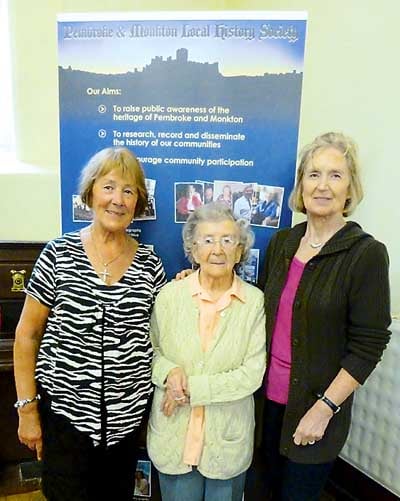
The New Year got off to a good start with a well-attended first meeting of the year, our Saturday coffee morning and exhibition on Saturday. We did not have a meeting in December so it was good to meet up with old friends and make some new ones as well. Some of the committee of the Llangwm Historical Society also joined us - it is good to make links with other heritage groups and we will be attending their meeting on February 11 at Llangwm Community Centre, the subject being one dear to Pembroke people: the Haggar silent movies. Any queries, please 'phone Jeff on 01437 890841.
The Story of Pembroke
Saturday's coffee morning featured an exhibition which has been a long time in preparation. Along with Terry John, whom I would like to thank so much for sharing the load of research, I have been working on a project to present the Story of Pembroke in a series of interpretation panels. Altogether, 14 boards trace the story of Pembroke from 10,000 BC to modern times - quite an undertaking really. And very difficult too to distil it into 14 boards - we had originally intended 10! Pembroke has an amazing history: so many of the great and famous are associated with it - it may be just a small town in the south west corner of Wales, but it has certainly played a big part in our nation's history.


12,000 years of history
I gave a brief talk, a quick whizz through 12,000 years just to give an impression of how amazing and important Pembroke is historically.
It is a story which began around 10,000 BC following the last great Ice Age. Pembroke, then, would have been covered by a glacier, but as the climate warmed, the land thawed sufficiently to sustain life. Then on to the scene came Pembroke's first human inhabitants, the Mesolithic (Middle Stone Age) Hunter Gatherers, nomadic peoples who sometimes took shelter in our caves at Wogan's Cavern and Priory Farm, or Catshole Cave, Monkton. We do not know much about the early peoples who lived here but monuments in our landscape - from cromlechs and standing stones to promontory forts - testify that people flourished here in prehistoric times. There may even have been an Iron Age Fort on the site where Pembroke Castle now stands.
The Founding of a Castle
Recorded history began with the Normans who, in 1093, overcame local resistance and built the castle, initially 'a slender fortress of stakes and turf'. From this strategically strong position, the Norman were able to form a powerbase wresting the whole of South Pembrokeshire from the native Welsh.
Great Connections
Many famous and powerful people are associated with Pembroke. The first castellan of Pembroke, Gerald de Windsor married the Welsh Princess Nest, lover of Henry I and reputedly the most beautiful woman of her time. Under the strong rule of the Earls of Pembroke, Pembroke thrived and was given special privileges by Royal Charter to encourage settlement: an English colony of English and Flemings was established, known forever after as Little England beyond Wales. There are great names among these Earls - Strongbow who led the conquest of Ireland, William Marshall who rose to become Regent of England and de Valence.
A Royal Birth
The spotlight was once again shone on Pembroke with the birth of Henry Tudor in Pembroke Castle. He never returned to Pembroke, but made his son Prince Henry, later Henry VIII, Earl of Pembroke who in turn briefly bestowed it upon his unhappy Queen, Anne Boleyn, Lady Marquess of Pembroke.
Despite its royal connections Pembroke did not fare well at this time: a contemporary source John Leland reported on its ruinous state 'the east suburbe hath ben almost as great as the town, but now it is totally in ruine'. Worse, under Henry VIII Acts of Union in 1536 and 1542, which annexed Wales to England, took away Pembroke's privileges: the County of Pembroke was created and Haverfordwest replaced Pembroke as the administrative centre. Pembroke, which had given its name to Pembrokeshire and was once the centre of a great earldom, was reduced to the status of a market town.
Civil War
Pembroke was to play one last leading role in British history and that happened during the Civil War 1642-1648. John Poyer, Mayor of Pembroke, supported Parliament in the first Civil War, which ended in 1644. However, he and his supporters were treated badly which eventually caused them to change sides and declare for the King in 1648. Pembroke became the springboard for a new rebellion which spread throughout Britain. This brought Oliver Cromwell himself to Pembroke. Pembroke was besieged for nearly two months and defeated. Cromwell wreaked his wrath upon us: the Castle was slighted and much of Pembroke's walls destroyed.
A Georgian Town
Pembroke never again played centre stage in national affairs, but does seem to have rallied somewhat after the devastation of civil war. The 18th century saw a revival in Pembroke's fortunes so much so that when Daniel Defoe visited Pembroke in 1724 he wrote: "Here is the richest and ...most flourishing town of all South Wales". There are many fine Georgian buildings in Pembroke dating back to the late 18th/early 19th century which would seem to denote a certain affluence.
However, by the early 19th century the port was declining in importance. However, the building of the Royal Dockyard a short distance away in 1814 gave Pembroke a boost. Many found employment in the new shipbuilding industry and Pembroke itself grew alongside the building of the new town of Pembroke Dock with suburbs at Orange Gardens and Monkton.
Modern Times
Modern times have seen great changes in Pembroke and much of the work of our society is concerned with recording memories and collecting and digitising photographs to build up a picture of our community in its many aspects.
Our focus is now on completing the 'Through My Eyes' project in which we are making digital stories with Pembroke people, stories which reveal much about our past and which we will publish as a dvd and book later this year (I hope!).
Contact
If you have any stories, photographs or feedback for this column, please contact me, Linda Asman, on 01646 622428, email [email protected]">[email protected] and visit our website http://www.pembrokeandmonkonhistory.org.uk">www.pembrokeandmonkonhistory.org.uk.
Next event
Friday evening January 18 is quiz night at Monkton Priory Church Hall, 7.30 pm. This is a fundraising event: £3.50 includes a lovely buffet - coffee and tea included, but bring your own bottle if you wish.
Comments
This article has no comments yet. Be the first to leave a comment.